


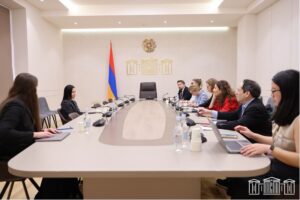
WASHINGTON D.C. (March 16, 2026) – The McCain Institute has released an assessment ahead of Armenia’s June 7 National Assembly Elections following a McCain Institute-led mission to Armenia February 23-26 supported by the Armenian civil society organization Union of Informed Citizens.
The delegation included experts on elections, the South Caucasus, foreign malign influence, and democracy. The goal of the visit was to evaluate the electoral landscape and identify risks to the integrity of the upcoming election in order to inform policy makers and publics in the United States.
A key takeaway from the mission is that the Armenian Apostolic Church is a pivotal political player in the pre-election period. The church, which, for long-standing historic and cultural reasons, enjoys widespread support from the Armenian population is currently headed by Catholicos Karekin II, who is actively campaigning against the incumbent Prime Minister Nikol Pashinyan. Another significant finding is that Armenian government bodies lack sufficient resources to effectively counter hybrid threats from Russia, as well as the corruption of political actors, in the run-up to the election.
“In the wake of Azerbaijan’s seizure of Nagorno-Karabakh in 2023 and the subsequent U.S.-brokered peace agreement in 2025, Armenians view this election as a critical step towards peace and stability. Just as in Moldova‚ where the McCain Institute conducted a similar assessment mission last year, Russian hybrid warfare is expected to pose a significant threat to Armenia’s ability to conduct free and fair elections and to propagate deceptive and inaccurate narratives regarding the peace process that could skew voter behavior,” said McCain Institute Executive Director Dr. Evelyn Farkas.
Recommendations for the Armenian government include:
- Facilitating information-sharing and enable rapid, coordinated responses to emerging electoral risks and threats by establishing an elections interagency task force.
- Enhancing coordination between the Central Electoral Commission and the Ministry of Internal Affairs in investigating allegations of transportation of and payments to Armenian citizens abroad to vote.
- Establish a mechanism that would allow the Central Electoral Commission and other oversight bodies to fill critical vacancies.
Recommendations for the U.S. include:
- Reinstating critical funding for independent media organizations and local civil society groups that provide essential reporting on politics, the economy, and foreign policy.
- Reinstating critical public diplomacy programs, including funding for the Voice of America and Radio Free Europe/Radio Liberty, and support for international organizations and others working to enhance local journalism and education as well as international election organizations
Recommendations for the U.S. and European governments include:
- Increasing technical assistance, financing, and training to (and enhance intelligence cooperation with) Armenian authorities to defend against foreign hybrid efforts.
- Enacting personal and financial sanctions for known pro-Russian operatives in Armenia, particularly those responsible for illegal financing schemes or sabotage efforts.
- Prepare for the potential contestation of results, as well as for how to ensure that whichever party forms Armenia’s next government continues to pursue the country’s democratic trajectory.
The McCain Institute offers this report in the spirit of democratic partnership with the aim of encouraging free and fair elections in June and a peaceful transition to the next parliament.
For the complete list of recommendations, view the full report HERE.
Learn more about the McCain Institute’s Global Democracy program HERE.