


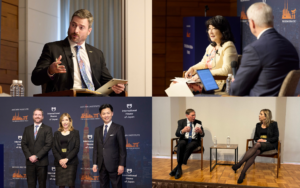
Top Left: Jack McCain, Top Right: Satsuki Katayama, Rick Davis, Bottom Left: Jack McCain, Dr. Evelyn Farkas, James Kondo, Bottom Right: Gen. (Ret.) David Petraeus and Dr. Evelyn Farkas
To watch all panel videos, click HERE.
TOKYO (January 16, 2026) – The McCain Institute at Arizona State University (ASU) and the International House of Japan (I-House) hosted the inaugural Sedona Forum – Tokyo, on January 15, 2026. The theme, “The U.S.-Japan Alliance — Advancing Freedom, Innovation and Security in Asia and Beyond,” covered topics ranging from China and Taiwan, global and diplomatic security challenges, technology and energy, and more. To watch all panel videos, click HERE.
Sedona Forum – Tokyo marks the first international expansion of the McCain Institute’s Sedona Forum, a premier policy forum that brings together leaders from the United States and around the world for candid and forward-looking discussions on global challenges convened annually in Sedona, Arizona.
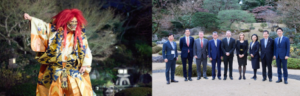
Left: Japanese Noh Dancer, Right: Attendees at the International House of Japan
“One message has come through clearly here in Tokyo: the future of global stability will be shaped in the Asia-Pacific,” said McCain Institute Executive Director Dr. Evelyn N. Farkas. “The quality of that future will depend on whether like-minded partners can align strategy, not just rhetoric.”
“When the world accelerates, when crises compound, and when institutions strain under the weight of events, the most valuable thing we can do is pause and think; to exchange ideas, to listen carefully across cultures, and to develop the relationships that allow democracies to respond with clarity rather than chaos,” said McCain Institute Board Member and McCain Advisory CEO Jack McCain.
“Bringing this conversation here felt timely and frankly necessary,” said Managing Director of the International House of Japan Ken Jimbo. “We are living in an era of abrupt exposure of national interests; decisions on security, technology, energy and supply chains are increasingly discussed almost exclusively through the lens of national interest. But… national decisions are rarely sustained alone, they are enabled by alliances and shaped by shared trust, shared access and shared expectations built over time… Strengthening the U.S. – Japan alliance actually makes America First more sustainable; it helps the US focus its priorities, avoid strategic overstretch, and rely on trusted partners who are willing to take their own responsibility.”
Noteworthy quotes from the event:
On being Japan’s first female Finance Minister:
“Everyone thought that politics would never change, but with women coming in, things are renewing,” said Minister of Finance Satsuki Katayama. “Prime Minister Takaichi was the icebreaker.”
On President Xi’s Taiwan ambition:
“Our objective should be that every single day as the sun comes up in Beijing, as President Xi gets up and pats himself on the back, looking wistfully out towards his Southeast… thinking about his one bucket list item left – reunification – what we need him to conclude is not today, and you just keep stringing together not today, not today, not today,” said KKR Global Institute Chair and McCain Institute Board Member Gen. David Petraeus.
On Taiwan’s importance to Japan:
“Treating Taiwan’s defense as a future contingency is no longer applicable. Taiwan is the frontline. If Taiwan falls… Japan will be the frontline and will bear the brunt of further Chinese aggression,” said Senior Advisor at the Taiwan Space Agency Holmes Liao. “Taiwan and Japan are うんめいきょうどうたい – unmei kyoudoutai, community of the same destiny.”
On global security:
“We have to realize that the U.S. has shouldered the burden to keep the peace and stability on this planet for too long, and we all have to share the burden… We need to create the institutions to do that,” said Japan House of Representatives Member Kono Taro.
To watch all panel videos, click HERE. To view a full list of event speakers, click HERE. To view a list of agenda topics, click HERE.