


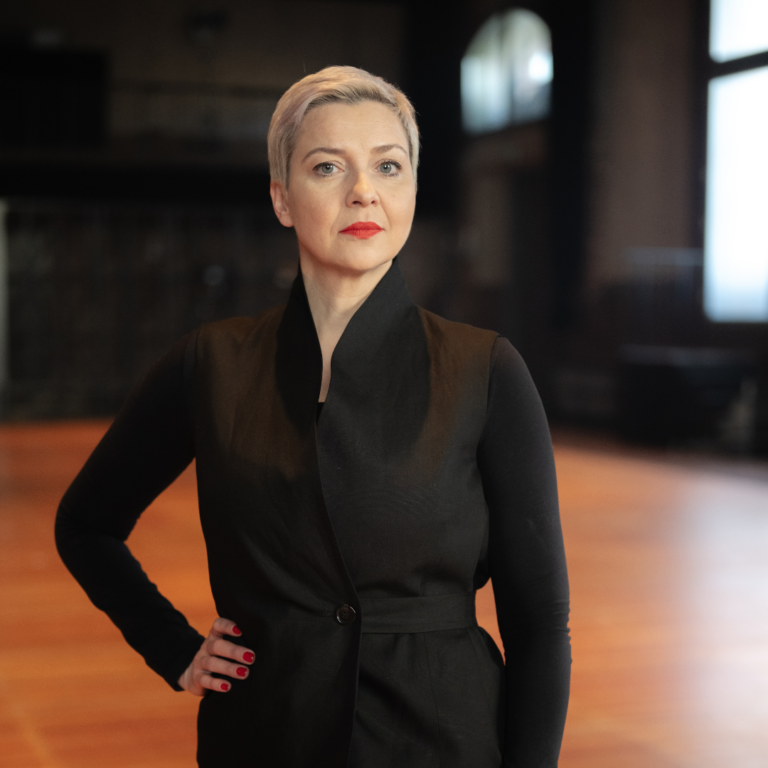
2026-2027 Kissinger Fellow
Maria Kalesnikava — Belarusian democratic leader, prominent voice of Belarusian civil society, and one of the leading figures of the country’s democratic movement.
In 2020, Maria Kalesnikava took a clear public political stance in support of democratic change, free and fair elections, the rule of law, and non-violent civic resistance in Belarus. Maria became the head of the campaign headquarters for Viktor Babaryka, one of the leading presidential candidates in Belarus. Following his arrest, she emerged as a key figure in the united opposition headquarters during the 2020 presidential election.
For her principled stance and unwavering commitment to democratic values, Maria was arrested and held as a political prisoner for 5 years. After more than 5 years of imprisonment, Maria Kalesnikava continues her political, artistic and civic work and is regarded as an outstanding example of the connection between artistic excellence, political will, democratic conviction, and civil courage.
In recognition of her outstanding contribution to the defense of democracy and human rights, she has received numerous international awards: Sakharov Prize for Freedom of Thought, the International Women of Courage Award, the Václav Havel Human Rights Prize, the International Charlemagne Prize. She also holds the title of honorary professor and has received an honorary doctorate in Austria.
Alongside her civic and political engagement, Maria’s artistic work remains a central part of her identity. Her practice brings together music, art, and public discourse, exploring questions of cultural identity, social responsibility, and political reflection.
She studied in Minsk and Stuttgart, completing two master’s degrees in Early Music and Contemporary Music. As co-founder of the InterAKT Initiative in Stuttgart and artistic director of the OK16 cultural hub in Minsk, she developed a number of pioneering international projects in the fields of culture, education, and social innovation.
The core focus of Maria’s work today is the belief that dialogue is essential to democracy. In a time of profound global change, she dedicates significant energy and expertise to fostering and sustaining this dialogue on a daily basis.