


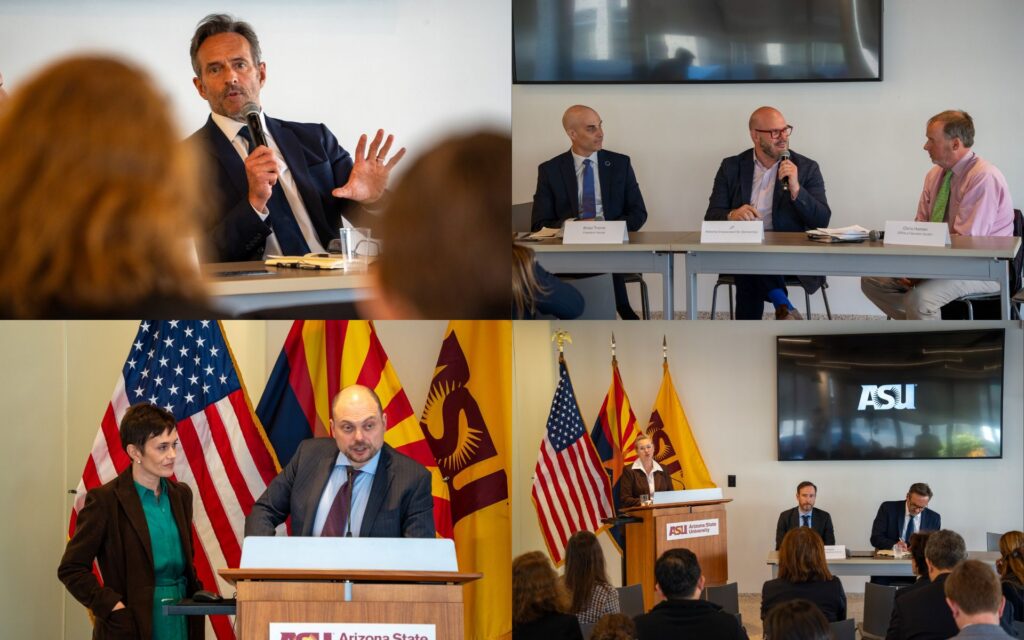
 Top Left: Amb. Roger Carstens; Top Right: Brian Tronic, John ‘JT’ Tomaszewski, Chris Homan; Bottom Left: Evgenia and Vladimir Kara-Murza; Bottom Right: Amb. Cindy Dyer (Ret.), Scott Mastic, Amb. Roger Carstens.
WASHINGTON, D.C. (October 30, 2026) – The McCain Institute’s John McCain Freedom for Political Prisoners Initiative (FPPI), in partnership with the October 30 Coalition, hosted an event entitled: “USG Leadership on Freeing Political Prisoners.” Featuring welcoming remarks by Chief Program Officer Cindy Dyer, two panel discussions with current and former government officials and staffers including Ambassador Roger Carstens, and closing remarks by Vladimir and Evgenia Kara-Murza, the event provided an inside look at the role the U.S. Executive Branch and Congress play in bringing attention to individual political prisoners and pressing for their release.
The event, attended by approximately 40 close friends and family members of current political prisoners, as well as civil society partners and advocates, drew on lessons from both past and current congressional and executive advocacy with the goal of giving these families and advocates concrete ideas and tools to better advocate for their loved ones unjustly held abroad. One of the family members in attendance was the wife of Ahmadreza Djalali (one of the FPPI’s named political prisoner cases), Vida Mehrannia, whom the McCain Institute supported to ensure her ability to attend and participate in the October 30 Coalition events to raise awareness about her husband’s case.”
The first panel discussion, moderated by Scott Mastic of the International Republican Institute in conversation with Ambassador Roger Carstens, the FPPI’s Distinguished Senior Fellow, reflected on the Executive Branch’s inter-agency leadership on behalf of political prisoners and dissidents, and the ways the Executive Branch has historically used its platform and influence to champion individual cases.
The second panel discussion was moderated by Brian Tronic of Freedom House, in a bipartisan conversation with Chris Homan, current Senior Advisor for National Security and Foreign Policy for Senator Dick Durbin (D-IL), and John ‘JT’ Tomaszewski, former Senior Professional Staff Member on the Senate Foreign Relations Committee (SFRC) and principal advisor to SFRC Chairman Jim Risch (R-ID). Focusing on the practical nature of their jobs in advocating for political prisoners, the panelists shared examples of approaches that have worked, lessons learned, and opportunities for offices to engage—including through case adoption, congressional correspondence, hearings and briefings, public advocacy, engagement with the Executive Branch, and direct outreach to families and advocates.
Vladimir and Evgenia Kara-Murza, Chair and Member of the FPPI’s Advisory Council, respectively, gave moving closing remarks about the importance of gathering together to create a stronger force to advocate for political prisoners’ releases. They also tied in the legacy of Senator John McCain, sharing one of his most memorable quotes: ‘Courage is not the absence of fear, but the capacity to act despite our fears.’
October 30 marks the International Day of Political Prisoners, an opportunity to recognize those who are unjustly imprisoned for exercising fundamental freedoms—including freedom of expression, association, religion or belief, and political participation. The October 30 Coalition, comprised of 10 organizations including the McCain Institute, Freedom House, National Endowment for Democracy, Human Rights Foundation, and 30 October Foundation, was created to commemorate the October 30 date with a number of events to rally support for political prisoners and champion their freedom. The Coalition released a joint statement HERE, and the series of events will wrap up with the Roll Call for Freedom, a public ceremony on the steps of the Lincoln Memorial on Friday, October 30 at 5 p.m.
About the McCain Institute at Arizona State University
The McCain Institute is a nonpartisan organization inspired by Senator John McCain and his family’s dedication to public service. We are part of Arizona State University and based in Washington, D.C. Our programs defend democracy, advance human rights and freedom, and empower character-driven leaders. Our unique power to convene leaders across the global political spectrum enables us to make a real impact on the world’s most pressing challenges. Our goal is action, not talk, and like Senator McCain, we are fighting to create a free, safe, and just world for all.
About Arizona State University
Arizona State University has developed a new model for the American research university, creating an institution that is committed to access, excellence and impact. ASU measures itself by those it includes, not by those it excludes. As the prototype for a New American University, ASU pursues research that contributes to the public good, and ASU assumes major responsibility for the economic, social and cultural vitality of the communities that surround it.