


Watch the video HERE
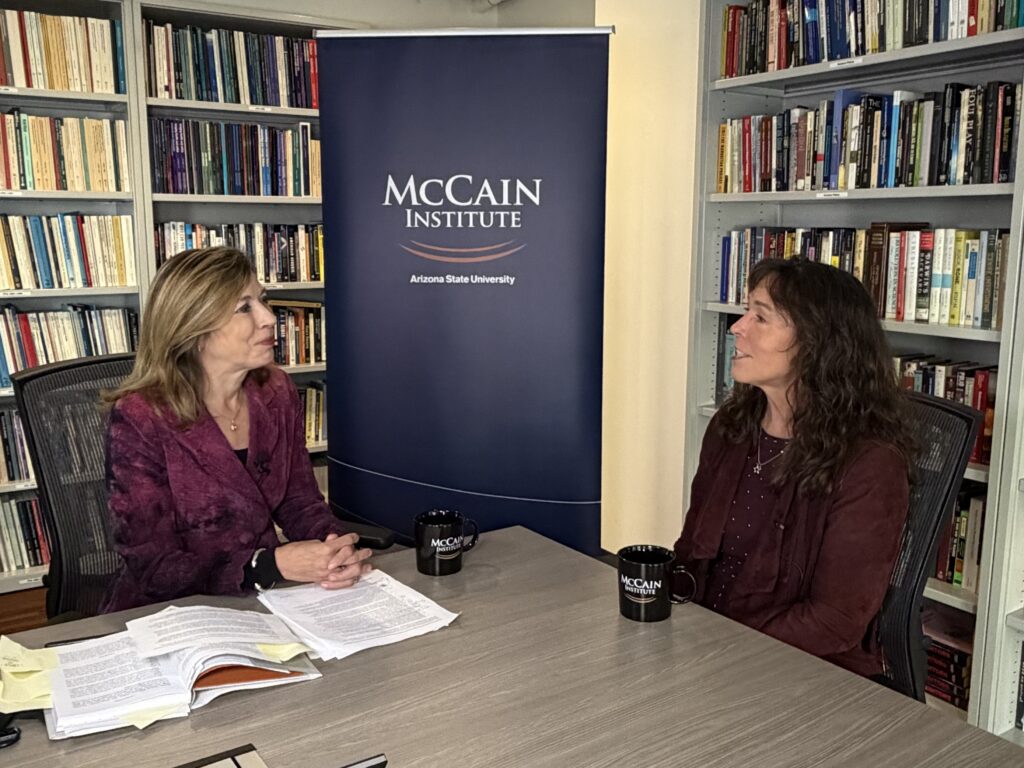
WASHINGTON, D.C. (October 28, 2026) – In the latest installment of the McCain Institute’s Authors & Insights series, McCain Institute Executive Director Dr. Evelyn Farkas interviewed Dr. Kori Schake, Director of the Foreign and Defense Policy Studies Team at the American Enterprise Institute, about her newest book, The State and the Soldier: A History of Civil-Military Relations in the United States.
The discussion analyzed historical and contemporary civil-military relations in the United States and the importance of balance of power between civilian politics and the armed forces.
Highlights from Kori Schake during the Authors & Insights event:
On Congressional control of the military:
“We often forget that it’s actually Congress that runs defense policy. It’s not the Department of Defense. If you want women to serve in combat or not serve in combat, Congress makes that decision. They control the budget. They control the promotions process, and so Congress actually has a lot more authority than it’s been exercising, but in some ways Congress has been putting political pressure on the military as well.”
On the civil-military relationship:
“The expectation that the military should determine what policies to enforce, or the idea that we’re going to rely on our military to save us from the people we have elected to office. You don’t have a republic if the military is making those choices, right? … what we should want from our military in this moment is to be politically inert, not to be a part of the process, but to be law-abiding and not politicized.”
On what action Congress should take right now:
“If there was one thing I could encourage, it is that Congress revise the Insurrection Act and tighten up the conditions under which an American president could lawfully use the American military in domestic, political, and other circumstances. I think that’s the one I worry about most. It’s 200-year-old legislation, and it was written at a time when the frontier was expanding, and you had a lot of concerns about law and order. It’s outdated. We should tighten it up.”
On U.S. Alliances:
“Alliances are the secret sauce of American power. It is how we share the burdens of what we are trying to accomplish in the world.
“It extends deterrence, so it helps stabilize some of the most war-torn areas, and it creates trust and confidence that countries will not just allow basing of our military but provide their military for wars we think need to be fought.
“Something I learned from Senator McCain that I honestly did not believe beforehand is that he understood it was not good enough to stand shoulder to shoulder with our current allies. That we had to actually invest our strength in countries that were trying to become democratic, that were lurching toward the West imperfectly, and that we had to stand shoulder to shoulder with them and help them in that process, because that’s how we make our country safer and more prosperous.”
Click HERE to view the complete discussion.
Previous authors have included USA Today’s Susan Page, former U.S. Senator Lamar Alexander, former U.S. Secretary of State Madeline Albright, journalist Anne Applebaum, former U.S. Secretary of Defense Dr. Mark Esper, CBS News’ Major Garrett and elections expert David Becker, former World Food Programme Executive Director Amb. Cindy McCain, CNN’s Jake Tapper, former POLITICO National Security Reporter Alex Ward, former U.S. Ambassador to Ukraine Marie Yovanovitch, and more.
The McCain Institute is grateful to the Merrill Family Foundation for the generous support of the Authors & Insights series.
About the McCain Institute at Arizona State University
The McCain Institute is a nonpartisan organization inspired by Senator John McCain and his family’s dedication to public service. We are part of Arizona State University and based in Washington, D.C. Our programs defend democracy, advance human rights and freedom, and empower character-driven leaders. Our unique power to convene leaders across the global political spectrum enables us to make a real impact on the world’s most pressing challenges. Our goal is action, not talk, and like Senator McCain, we are fighting to create a free, safe, and just world for all.
About Arizona State University
Arizona State University has developed a new model for the American research university, creating an institution that is committed to access, excellence and impact. ASU measures itself by those it includes, not by those it excludes. As the prototype for a New American University, ASU pursues research that contributes to the public good, and ASU assumes major responsibility for the economic, social and cultural vitality of the communities that surround it.