


Click HERE to watch the event.
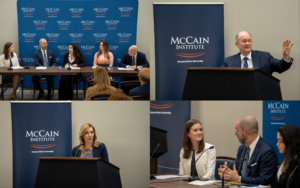
WASHINGTON, D.C. (June 10, 2026) – The McCain Institute at Arizona State University (ASU) hosted an event in the U.S. Senate on June 9 highlighting its report, “The State of Religious Freedom Worldwide: An Inside Look at the Axis of Upheaval’s Religious Persecution and How the U.S. Can Counteract It.” U.S. Senator Chris Coons (D-Del.), co-chair of the Senate Human Rights Caucus along with U.S. Senator Thom Tillis (R-N.C.), gave opening remarks.
“Senator Tillis and I have stood together for years in defense of religious minorities around the world, because protecting this fundamental freedom should never be a partisan issue,” said Senator Coons. “Whether you are a Uyghur Muslim in China or a Bahá’í in Iran, the United States must use every diplomatic tool at its disposal to stand up for those being persecuted for their faith. I’m happy to join the McCain Institute to ensure the U.S. is a leader on protecting religious freedom around the world.”
“The Axis of Upheaval – which is comprised of China, Russia, Iran, and North Korea – regularly commits egregious acts of religious persecution” said McCain Institute Executive Director Dr. Evelyn Farkas. “The McCain Institute’s report documents these acts of religious persecution and the motivation behind them as we work to protect religious freedom and combat the Axis of Upheaval’s human rights abuses.”
The event featured a panel of experts who contributed to the report including McCain Institute Human Rights and Freedom Senior Program Manager Alexis Mrachek, Dallas Baptist University Everett Center for Global Religious Freedom Executive Director Knox Thames, Hudson Institute Senior Fellow Olivia Enos, Worker Rights Consortium Forced Labor Project Manager and Coalition to End Forced Labour in the Uyghur Region Spokesperson Jewher Ilham, and George Mason University’s International Affairs Professor and Center for Global Islamic Studies Director Peter Mandaville.
“Senator John McCain was a steadfast proponent of international religious freedom, which is why the McCain Institute commissioned this report to shed light on the Axis of Upheaval’s persecution of religion,” said McCain Institute Human Rights and Freedom Senior Program Manager Alexis Mrachek. “Nine authors, including myself, penned chapters from different angles, describing explicitly the Axis of Upheaval’s acts of repression against a number of religious groups, including Buddhists, Muslims, Jews, Christians, members of the Bahá’í community, Falun Gong practitioners, and others.”
“It’s not surprising that these four countries are religious persecution machines—they expend incredible amounts of energy to arrest their own people, to limit their own people’s ability to pursue truth, and they consciously spell fear, discrimination, or violence,” said Dallas Baptist University Everett Center for Global Religious Freedom Executive Director Knox Thames. “In this report, we don’t just identify the problem, but we also try to identify some solutions, and the unique role for the United States to play to push back the forces of persecution.”
“North Korea, bar none, is the world’s worst persecutor of Christians,” said Hudson Institute Senior Fellow Olivia Enos. “Evidence suggests that North Korean Christians may be facing genocide in addition to crimes against humanity.”
“My father reported and documented [the Chinese government’s crackdown against the Muslim communities]. Growing up I had bugging devices in our living room, I was followed and picked up by authorities from my school, and we were house arrested multiple times…In 2014 he was one of the first scholars targeted, and he was sentenced to life imprisonment,” said Worker Rights Consortium Forced Labor Project Manager and Coalition to End Forced Labour in the Uyghur Region Spokesperson Jewher Ilham. “I’m considered one of the lucky ones, I escaped China, but there are many people who are not able to, who are silenced, and who are trapped in the state-sponsored forced labor programs working day and night because of their ethnic and religious identities”
“More countries are starting to use religion as an instrument of statecraft in order to advance certain kinds of agendas, and I think when it comes to how we think about and practice the promotion of international religious freedom, it’s vitally important to be aware of that broader landscape,” said George Mason University’s International Affairs Professor and Center for Global Islamic Studies Director Peter Mandaville. “This isn’t just about calling out human rights violations and violations of religious freedom; it’s about doing so in an emerging world order in which the geopolitical resonance of religion is evolving very quickly and in fundamentally different ways.”
A video recording of the event is available HERE. To read the report, click HERE. To learn more about the McCain Institute’s Human Rights and Freedom program, click HERE.