


Dialogue focused on bipartisan approaches to artificial intelligence, the Iran conflict, foreign policy, and more.
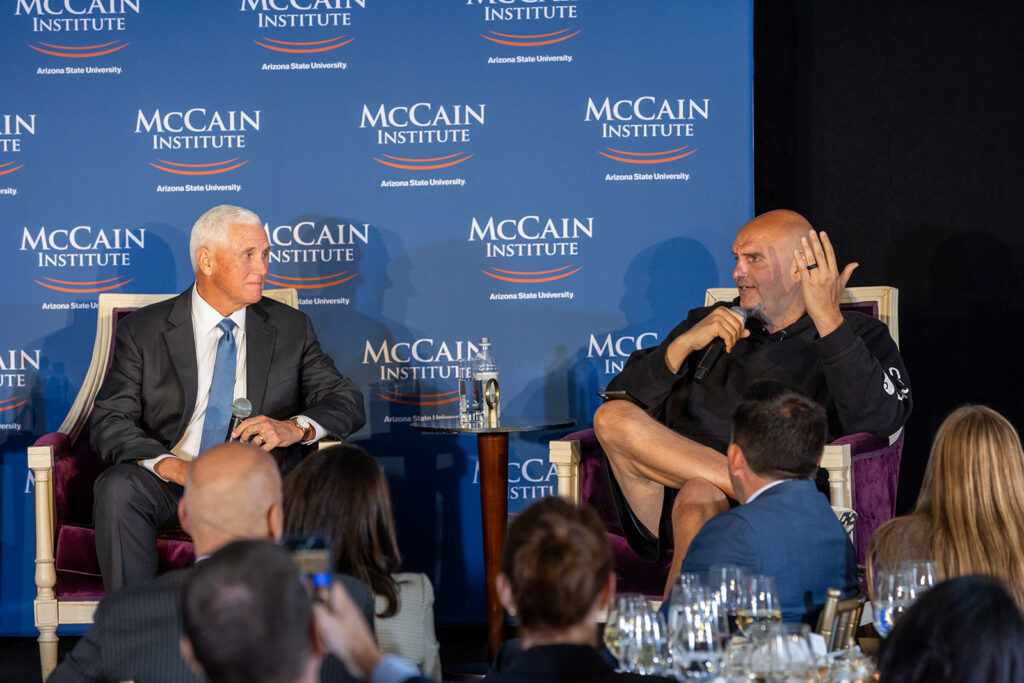
Click HERE or the photo above to view the panel discussion.
Washington, D.C. (October 23, 2026) – The McCain Institute at Arizona State University (ASU) hosted Vice President Mike Pence and U.S. Senator John Fetterman (D-Pa.) in conversation with Bloomberg Television’s Chief Political Correspondent Annmarie Hordern at an event focused on finding common ground and bipartisan cooperation. The conversation was part of the McCain Institute’s annual New York convening of bipartisan leaders in democracy, human rights, national security, technology, global leadership, and philanthropy.
Senator McCain’s core values defined his four-decade career on Capitol Hill. From the beginning, he established a reputation as a pragmatic leader who put country over party. Senator McCain was an ardent conservative, but that did not stop him from joining forces with colleagues across the political spectrum when progress demanded bipartisan action. The McCain Institute carries forward that commitment to progress over politics and finding common ground.
“Common ground is something John [McCain] believed to his core, that our country is strongest when we have the courage to come together, especially when it’s not easy,” said McCain Institute Board Co-Chair Ambassador Cindy McCain. “For John, finding common ground was never a slogan; it was a discipline, a responsibility, and at times an act of courage … Bipartisanship was not about giving up what you believe; it was about being strong enough in your beliefs to sit across the table from someone who saw the world differently, listen honestly, argue honestly, and search for a way forward.”
Vice President Mike Pence spoke about his relationship with Senator John McCain during his time as a U.S. Representative (R-Ind.), the Governor of Indiana, and the Vice President, reflecting on trips with Sen. McCain overseas during conflict in the Middle East, Sen. McCain’s work in the Senate, and his character.
“[John McCain] taught us that in this great experiment of freedom, we are not to put Republicans first, we are not to put Democrats first, we are to put country first,” said Vice President Mike Pence. “I think John understood that if we simply encourage and support a model for a generation of leaders, Republicans, Democrats and Independents across this country, simply to be men and women of integrity … we will find our way forward, John in a very real sense, taught us that the best of this nation is still possible.”
Highlights from the conversation between Vice President Mike Pence and Senator John Fetterman (D-Pa.):
Vice President Mike Pence on political divide: “I think our politics are more divided today than any time in my lifetime and I’m just not convinced the American people are as divided as our politics … you get 15 miles out of Washington, D.C. the people in this country get along pretty well … the people of this country know how to respect one another, how to be there for one another in agreement or disagreement. We just need to return that threshold of civility to public life, and I believe we will, and we will soon.”
Sen. Fetterman on bipartisanship: “I know and I love a lot of Republicans. They’re not bad people. They’re good, great Americans. This idea, that you have a different party and that they’re terrible – that’s just not true. So, I think people forgot that now, and we have forgotten that we need each other, and that’s really going in the wrong direction.”
Sen. Fetterman on issues requiring bipartisanship: “Social Security … our debt $40 trillion, and AI. You can’t fix that by one party, these are three gigantic things that require bipartisanship, and the only way that works is if one side trusts another … what’s the answer if we continue to become more and more fractured and bitter when you have those really big problems.”
Vice President Mike Pence on bipartisanship: “I think bipartisanship is more about how you deal with one another than it is what the outcome is. I think you can have a principled compromise. You can find genuine common ground on issues, but it all begins with respecting the right of that person to hold the views that they hold”
Vice President Mike Pence on Iran conflict: “I think the president’s decision to take the fight directly to the Mullahs in Tehran for the first time in history, despite the fact that we’re in a difficult period on the war right now, even if it costs the Republicans the midterms … we are doing what is right in history, and we should support the administration’s efforts all the way through until we create the conditions where the people of Iran can reclaim their freedom. That would literally change the world.
“I think that politics should never play one scintilla of a role in decisions about whether to put Americans in harm’s way. That should be driven exclusively by the national security interests of the United States of America. And what I would say is the job that our military did in those first four and a half weeks was brilliant.
“I know President Trump well enough to know that he is not interested in forever wars. He doesn’t want to be there 10 years from now, parked in the region, dealing with Iran, and I would fully expect at the time and manner of our choosing, the commander in chief will let our armed forces go in and do what needs to be done again to create the conditions on the ground for the people of Iran to reclaim their country.”
Sen. Fetterman on the Iran conflict: “It was really the absolutely right call to bomb the Iranian nuclear facilities … when someone does something about it, I’m going to support it regardless of the name, or the letter after it.”
Vice President Mike Pence on tariffs: “The broad-based tariffs on friend and foe alike, I think, the Supreme Court was right to recognize as unconstitutional. The tariffs, the Constitution, Article One, Section Eight says that the ability to impose taxes and tariffs belongs to the Congress … in the first Trump administration, we used tariffs and the threat of tariffs to open up around the world, not to close down and put burdens on American taxpayers.”
Sen. Fetterman on artificial intelligence: “We face a risk with AI, without a doubt, but people are calling for a moratorium. Congratulations, the Chinese would love that, you know, because then they will hit the gas, and we will live the rules of the AI that they create. We have to win. This is a Manhattan Project … I’m grateful that the frontier models are in our hands, could you imagine if they were in Iran or any other nations?”
Vice President Pence on artificial intelligence: “We need a marketplace that is diverse enough, not three big behemoths figuring things out … Let’s use this technology in ways that enhances quality of life and the productivity of the American people, the marketplace will have the wisdom to sort that out. Government never will … The AI the American people want essentially respects individual liberty, privacy, private property – avoids intellectual property theft, but also that basic respect for human life at the bottom of it. If we lose this fight to China, none of those things will be a part of AI.”
A recording of opening remarks from Amb. McCain and Vice President Pence is available HERE.
A recording of the panel discussion is available HERE.
To learn more about the McCain Institute, click HERE.
About the McCain Institute at Arizona State University
The McCain Institute is a nonpartisan organization inspired by Senator John McCain and his family’s dedication to public service. We are part of Arizona State University and based in Washington, D.C. Our programs defend democracy, advance human rights and freedom, and empower character-driven leaders. Our unique power to convene leaders across the global political spectrum enables us to make a real impact on the world’s most pressing challenges. Our goal is action, not talk, and like Senator McCain, we are fighting to create a free, safe, and just world for all.
About Arizona State University
Arizona State University has developed a new model for the American research university, creating an institution that is committed to access, excellence and impact. ASU measures itself by those it includes, not by those it excludes. As the prototype for a New American University, ASU pursues research that contributes to the public good, and ASU assumes major responsibility for the economic, social and cultural vitality of the communities that surround it.