


Alumni from across Europe and Eurasia convene to strengthen regional collaboration and democratic resilience
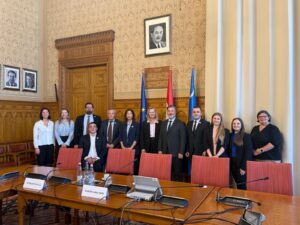
McCain global leaders meet with Mr. Csaba Attila Bakos, Chair of the Committee on Defense and Law Enforcement, during visit to Hungarian National Assembly.
WASHINGTON, D.C. (September 29, 2026) – The McCain Institute at Arizona State University (ASU) gathered McCain Global Leaders (MGL) alumni in Budapest, Hungary, for a regional convening focused on strengthening democracy through collaboration, shared learning and collective action in Eastern Europe and Eurasia.
The MGL alumni convened to examine the drivers and impacts of democratic backsliding and authoritarian threats, exchange lessons from across their countries, and identify opportunities for regional collaboration. Attendees included Giorgi Akhmeteli of Georgia, Capt. Jeta Berisha of Kosovo, Nino Dolidze of Georgia, Irina Gotișan-Sotnic of Moldova, Elmas Hasanovikj of North Macedonia, Amb. Batu Kutelia of Georgia, Nikoloz Khatiashvili of Georgia, Dr. Péter Klotz of Hungary, Dr. Mariia Levchenko of Ukraine, and Aliz Pocsuvalszki of Hungary. The delegation was also joined by McCain Institute Chief Program Officer, Amb. Cindy Dyer.
“Democracy depends on leaders who are willing to defend it, especially when democratic institutions and civil society are under pressure,” said Amb. Dyer. “The alumni gathered in Budapest bring firsthand experience confronting these challenges in their own countries, and their ability to learn from one another and work across borders is critical to strengthening democracy throughout Europe and Eurasia.”
During the gathering, alumni explored issues including rule of law, the role of civil society, public accountability, corruption, and the resilience of democratic institutions. They met with civil society leaders, anti-corruption experts, and visited the Hungarian National Assembly to engage with representatives and learn more about Hungary’s political and legislative landscape.
“Authoritarian pressure is designed to create fear, exhaustion, and even a sense of hopelessness – that our fight is senseless. But when our freedom, human dignity, and the future of our societies are at stake, standing aside is not an option,” said Nino Dolidze, 2023 MGL cohort member. “True leadership is the courage to act when it is hardest, to defend democracy, stand with those whose voices are being silenced, and keep freedom alive. When we stand together, with courage, solidarity, and determination, we will prevail.”
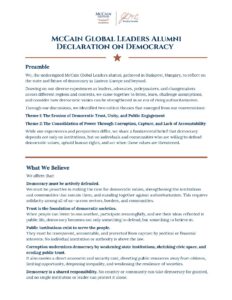
Drawing on these conversations and their own experiences, the alumni identified two of the most pressing shared challenges facing democracy across Europe and Eurasia and examined how challenges show up in different national contexts. The convening culminated in the collaborative development and adoption of a declaration of shared principles, priorities, and concrete commitments for strengthening democratic resilience and regional collaboration.
“Political changes in Hungary offer practical lessons and tools that are useful and applicable across Central and Eastern Europe,” said Péter Klotz, a 2014 McCain Institute leadership alum. “An important lesson is that through social solidarity, mobilization, and hard work, even seemingly hopeless political situations can be turned around, and the scales can be tipped in favor of democracy.”
Read the full declaration HERE.
To learn more about the McCain Global Leaders Program, click HERE. Follow their journey on Instagram, LinkedIn, and X.
About the McCain Institute at Arizona State University
The McCain Institute is a nonpartisan organization inspired by Senator John McCain and his family’s dedication to public service. We are part of Arizona State University and based in Washington, D.C. Our programs defend democracy, advance human rights and freedom, and empower character-driven leaders. Our unique power to convene leaders across the global political spectrum enables us to make a real impact on the world’s most pressing challenges. Our goal is action, not talk, and like Senator McCain, we are fighting to create a free, safe, and just world for all.
About Arizona State University
Arizona State University has developed a new model for the American research university, creating an institution that is committed to access, excellence and impact. ASU measures itself by those it includes, not by those it excludes. As the prototype for a New American University, ASU pursues research that contributes to the public good, and ASU assumes major responsibility for the economic, social and cultural vitality of the communities that surround it.